How Viettano Shoes Are Made: Inside a Handmade Shoes Brand
What separates a genuine handmade shoes brand from one that merely says so is visible in the making. Viettano shoes are handcrafted to order — cut, lasted, welted, and finished by experienced artisans — using materials chosen to last and methods designed to be repaired rather than replaced. This guide goes inside that process: the leather, the construction, the finishing, and the made-to-order model that lets a handmade pair reach you without a four-figure price tag. Understanding how a shoe is made is the surest way to judge whether it is worth owning. Beyond appearance, the way a shoe is made determines how long it lasts, how comfortably it molds to your feet, and whether it can be repaired years later. Looking beyond the finished product reveals the craftsmanship that distinguishes genuine handmade shoes from mass-produced alternatives.
What 'Handmade' Actually Means
‘Handmade’ is among the most overused words in footwear, so it is worth defining. For a true handmade shoe brand, this means the critical stages — cutting the leather, shaping it over the shoe last, stitching the welt, and finishing the surface — are done by skilled hands rather than being stamped out by machine. The result is a pair with the small variations and durability that mass production cannot reproduce. At Viettano, artisans with years of bench experience make each pair this way, only after it is ordered.
Handmade does not mean every operation is performed without tools or machinery. Modern workshops still use specialized equipment for consistency and precision where appropriate. What defines a genuine handmade shoe brand is that the critical stages requiring craftsmanship, judgment, and experience remain in the hands of skilled artisans rather than being fully automated.
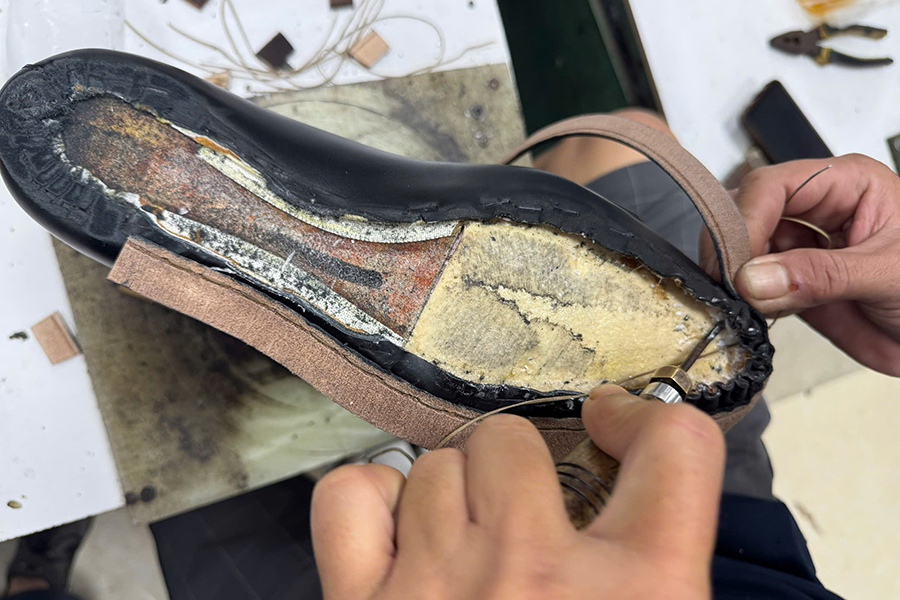
In a genuine handmade brand, the critical stages are done by experienced hands, not machines
The Materials: Full-Grain Leather
Every fine shoe begins with its leather. Viettano works in full-grain leather — the topmost, most durable layer of the hide, which keeps its natural grain and develops a patina over years of wear. Where appropriate, suede and patent leather are offered for relaxed and formal pairs, respectively. Full-grain is harder to work with and costlier than corrected or bonded leather, but it is the difference between a shoe that ages beautifully and one that simply wears out.
Unlike corrected-grain or bonded leather, full-grain leather retains the strongest fibers of the hide, making it more durable while allowing it to develop a rich natural patina through years of wear. Small variations in texture are not imperfections but characteristics that make every pair unique.
The Construction: Goodyear Welt
Construction is where a shoe's lifespan is decided. Viettano uses Goodyear construction, in which a strip of leather — the welt — is stitched to both the upper and the sole. The advantage is simple but significant: the sole can be removed and replaced without harming the upper, so the pair can be resoled and restored for years rather than discarded when the sole wears. It is the quiet engineering behind a shoe worth keeping, and a reliable mark of a serious handmade brand.
Although Goodyear welt construction requires more time and skill than simpler manufacturing methods, it offers significant long-term advantages. The structure provides excellent durability, improves water resistance around the welt, and allows the outsole to be replaced multiple times without affecting the upper leather. For customers who expect to wear the same pair for many years, these benefits often outweigh the longer production time and higher manufacturing cost.
|
Construction |
Resoleable? |
Typical lifespan |
|---|---|---|
|
Goodyear welt / Bolognese |
Yes, repeatedly |
Many years, resoled |
|
Blake stitch |
Yes, limited |
Several years |
|
Cemented (glued) |
No |
Until the sole wears |
Each construction method serves different needs. Cemented shoes prioritize affordability and lightweight production, Blake stitch balances flexibility with repairability, while Goodyear welt construction is generally preferred for premium leather dress shoes intended to last for many years.
The Finishing
Once constructed, each pair is finished by hand: the toe cap and heel are burnished for depth, edges are dressed and colored, and any personalized detail — broguing, a contrast edge, a monogram — is added. This is the stage that turns a well-built shoe into a distinctive one, and it is done pair by pair rather than in bulk, by artisans who have refined the technique over many years.
Because every pair is finished individually, subtle variations naturally occur from one pair to another. These small differences are a hallmark of handcrafted footwear and reflect the work of skilled artisans rather than the uniform appearance produced by automated manufacturing.
Quality Control
Before any pair leaves the workshop, it passes a careful inspection. Each shoe is checked for even stitching along the welt, symmetry between the left and right of the pair, a clean and consistent finish on the leather, secure heel and sole attachment, and a smooth interior with no rough seams. The measurements the shoe was built to are verified against the finished last, and the burnishing and edge color are examined in good light for evenness. Only once a pair meets this standard is it cleaned, conditioned, and packed for delivery. Because every pair is made individually rather than in a batch, this final check is personal — a last confirmation, by an experienced eye, that the shoe is worthy of the person who designed it.
This final inspection is not simply about appearance. It confirms that the craftsmanship, construction, and personalized specifications all meet the standards expected of a handmade pair before it reaches the customer.
The Made-to-Order Model
Viettano builds nothing until it is ordered. You design a pair online — silhouette, leather, sole, finish — and only then does the workshop begin. This made-to-order model is what allows a handmade shoe brand to offer customization affordably: there is no unsold inventory, no showroom, and no markup to cover them. The trade-off is time — around five weeks — which is the one part of handcraft that cannot be hurried. For many customers, waiting a few weeks is a worthwhile exchange for receiving a pair that has never sat on a warehouse shelf and has been produced specifically to their design choices rather than for anonymous inventory. For the wider case for buying this way, see custom shoes vs off-the-rack.
Why Handmade Leather Shoes Cost More

Handmade shoes are often more expensive than mass-produced footwear because they require significantly more skilled labor, higher-quality materials, and longer production times. Rather than assembling thousands of identical pairs on a production line, experienced artisans work on each pair individually, paying close attention to details such as leather selection, lasting, welting, and finishing.
Premium materials also contribute to the cost. Full-grain leather, durable soles, and Goodyear welt construction are considerably more expensive than the materials commonly used in fast-fashion footwear, but they also provide greater durability and the possibility of repair.
The higher initial price reflects the time, craftsmanship, and longevity built into every pair. Instead of replacing shoes every few years, many owners choose to maintain and resole well-made leather shoes, allowing them to remain in service for far longer than standard footwear.
Frequently Asked Questions
Are Viettano shoes really handmade?
Yes. The critical stages — cutting, lasting, welting, and finishing — are done by hand by experienced artisans, and each pair is built to order rather than mass-produced. The Goodyear construction and full-grain leather are hallmarks of genuine handcraft.
What is Goodyear construction, and why does it matter?
It is a method where a leather welt is stitched to both the upper and sole, allowing the sole to be replaced without damaging the shoe. It matters because it lets a pair be resoled and kept for years, rather than discarded when the sole wears out.
Why do handmade shoes take weeks to arrive?
Because they are made to order, nothing is built until you place the order, so the leather is cut, shaped, welted, and finished specifically for you — a process that takes around five weeks and cannot be rushed without cutting corners.
Conclusion
A true handmade shoe brand reveals itself in its materials, construction, and finishing — full-grain leather, a Goodyear welt that can be resoled, and details applied by experienced hands. That is how Viettano shoes are made, and why they are built to be kept. Understanding how Viettano shoes are made also explains why carefully crafted footwear often becomes a long-term investment rather than a short-term purchase. Explore Viettano's custom dress shoes and see the craft for yourself.